Section outline

    • Some directors hold special offices, whose responsibilities will be defined in the organization's bylaws. Some offices are common to all boards, such as chair, treasurer and secretary, while others may be created by the board depending on the needs of the organization. The bylaws will usually stipulate term limits for these officers (typically from one to two years) and other limitations, such as no consecutive appointments. 

    • See if you can guess what each office the board members hold. Click the hotspots for the answers. What roles interest you?

    • The chair

      The role of the chairperson will vary widely depending on the organization, the board and even the chair themselves. Contrary to popular belief the chair is rarely a boss. In fact, many will only vote to break a tie, taking a neutral position during discussions. One governance expert emphasizes the role of the chairperson in promoting diversity of thought, by making sure that everyone at the table is heard. For some, however, the chair should take a leadership role, setting the meeting agendas and acting as the key spokesperson for the board.  

      As president of the board of a campus station, Ken Zakreski said his main role was just finding qualified colleagues.

    •  

      Role of President

      Ken Zakreski 

    • All the offices come with their challenges and rewards. One of the  most important, says Brandon Logan, is secretary.

    • The secretary

      Brandon Logan 


    • Committees

      Boards will be subdivided into committees, smaller groups of directors (between three and five is a recommended size) assigned to work on special topics. Their small size allows them to work more quickly and efficiently than the board as a whole. Staff members or even outside experts may be invited to increase the committee's expertise.

      Committees typically conduct research, make recommendations to the board, organize events, and prepare key documents such as the budget, tax filings or policies. They do not usually have decision-making powers.

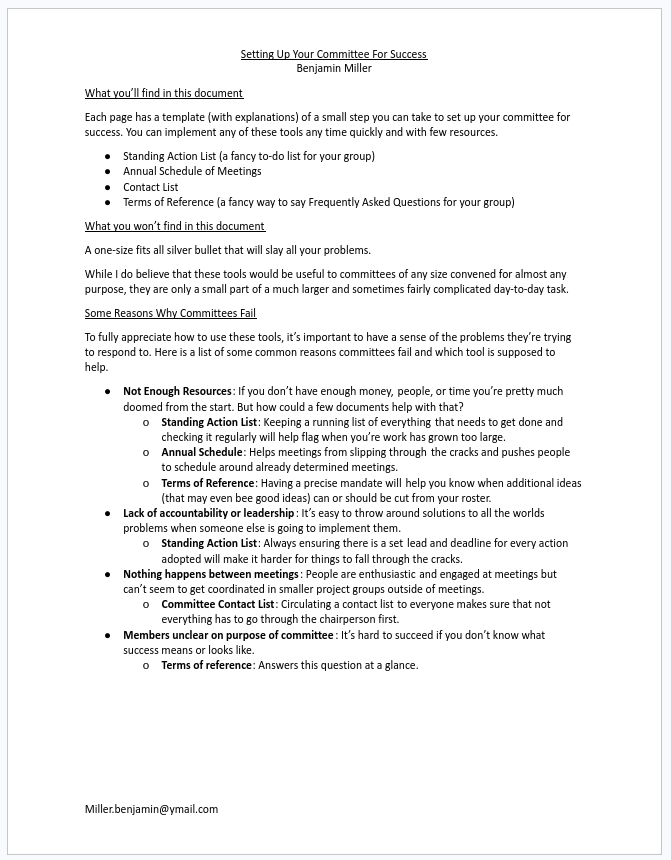
    • Setting up your committee for success

      Benjamin Miller

      A helpful primer for setting up a committee, with tools and tips you can follow (NCRA members only).

    • Two types of committee

      There are two categories of committee:

    • Standing committees

      Permanent committees that deal with ongoing issues. Their mandate is generally stipulated in the organization's bylaws. Common standing committees include:

    •  

      Finance

      Reviews bank statements, helps prepare the budget, tax filings and financial audit, unless a separate audit committee has also been created.



      Governance

      Proposes policies and bylaw amendments that affect the functioning of the board itself. May also nominate new directors, unless a nominating committee also exists.

      Human Resources

      Makes recommendations on staff compensation, benefits, hiring and workplace policies. 

      Fundraising

      Researches grants and helps write grant proposals, as well as overseeing fundraising events.

    • Ad hoc committees

      Temporary committees are formed through a resolution of the board to deal with an immediate or short term issue. Examples of issues that an ad hoc committee may be created for include:

    •  

      Crisis Management

      Rent is going up on campus! This committee will look into alternative locations, and avenues to negotiate a new rate with the university.

      Purchasing

      The station needs a new mixer. This committee will research prices, deals and suppliers.

      Special Event

      Liase with university staff and volunteers to organize a live homecoming broadcast.

    • Executive Committee

      This is a special standing committee with executive, or decision making powers. It may "bind" the organization, making payments, entering contracts and buying and selling property. An executive committee allows an organization to conduct business even when the board as a whole is not in session.

    • An executive committee can be very powerful, and there are legal safeguards to prevent it usurping the power of the board as a whole. Accordering to Peter Broder, "they cannot be delegated authority to distribute assets, dissolve or merge the corporation, or take other decisions affecting the fundamental mandate or structure of the corporation" (Broder, Primer for Not-for-Profit Directors.)

    • Assign tasks to different committees

    • Keeping Committees Efficient

      Committees can be a way to keep the board nimble. But they can have the opposite effect if they are not managed well. BoardVoice has a checklist to make sure your committees are serving you well. Tick the ones that apply to your board.

      • Members feel they are contributing meaningfully to the organization
      • Every member has a chance to be involved in a committee
      • Committees promote board-staff interactions
      • Members are clear about the roles of the committee
      • The mandate of a committee continues to be relevant
      • A committee only takes on tasks within its mandate
      • The board has a reasonable number of committees, so members do not feel stretched thin
      • Committees are neither too large nor too small to be effective
      • Committees refrain from taking over the operational tasks of staff
      • The executive committee refrains from taking over the role of the board as a whole

      Hopefully you ticked more than half of these. Less than that and you might need to rethink the structure of your committees!

    • Are your committees feeling bloated and ineffective? BoardVoice recommends zero-based committee structure. Every year (or two years depending on the appointment periods of your directors) the boards disbands all existing committees and starts again.  

    • Terms of reference

      Committees are always created with terms of reference, a document that describes the mandate, composition and procedures of the committee. Without terms of reference, a committee is liable to go off the track, either taking on too much work, the wrong work or even no work!

      At a minimum, the terms of reference should stipulate the following, according to Primer for Not-for-Profit Directors:

      • how the chair is selected
      • how many members (minimum and maximum) and how they are selected
      • to whom the committee reports and how often
      • the scope of authority (does it advise, report, research, act, etc?)
      • resources (including any budget) and staff support

      You can find a model terms of reference document in the Board Governance Guidebook from the Alberta Association of Agricultural Societies.

    • The Board Governance Guidebook

      The Alberta Association of Agricultural Societies

      An overview of the roles and responsibilities of a non-profit board. The document starts with a tripartite concept of Strategic, Generative and Fiduciary responsibilities, then examines each in detail. It also includes useful sample documents, tools and checklists.