Section outline

    • A board of directors in an organization's chauffeur. Its task is to guide the organization to a destination, or at the very least keep it from going off the road. To avoid backseat drivers, last minute decisions and aimless trips around the block, the board needs to keep some documents in its glove comparment. These are the maps, owner's manuals and driver's handbooks of non-profit governance.

    • Chances are, you're joining a board that already has the documents we're going to discuss in this module. Nevertheless, it's a good idea to find out how they come about, in case you ever need to help revise them.

    • Purpose statement

      Sometimes called the objects of an organization, the purpose statement is officially registered with the government at the time of an organization's incorporation. It is a legally binding statement of the activities the organization will conduct, and to which it will confine itself. 

      The purpose statement of CHLY in Nanaimo, BC reads:

      • To provide, local and Canadian, Actors and musicians a broadcast platform on an alternative community radio station; 
      • To offer the general public an intelligent, innovative, entertaining alternative to the programming fare currently offered; 
      • To communicate with the highest standards of journalism the concerns, interests, and attitudes of the campus, broadcast community, as well as the academic environment to the general public; 
      • To give groups from the campus/community (other than partisan political or religious groups) an opportunity to communicate with their members and with the general public; 
      • To give individuals an opportunity to develop and use their creative talents on the radio.

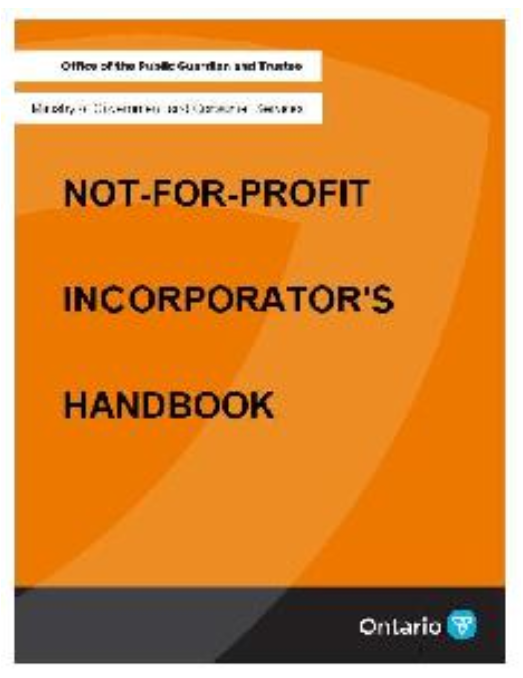
      You can see many more purpose statements, and read more about incorporating a non-profit in the Not-for-profit Incorporator's Handbook.

    • Not-for-profit Incorporator's Handbook

      Government of Ontario

      This document focuses on the regulatory steps involved in incorporation, maintaining good standing, through to dissolution of a non-profit. Topics covered include registering a corporations name, creating bylaws, changing the composition of the board and auditing.

    • Bylaws

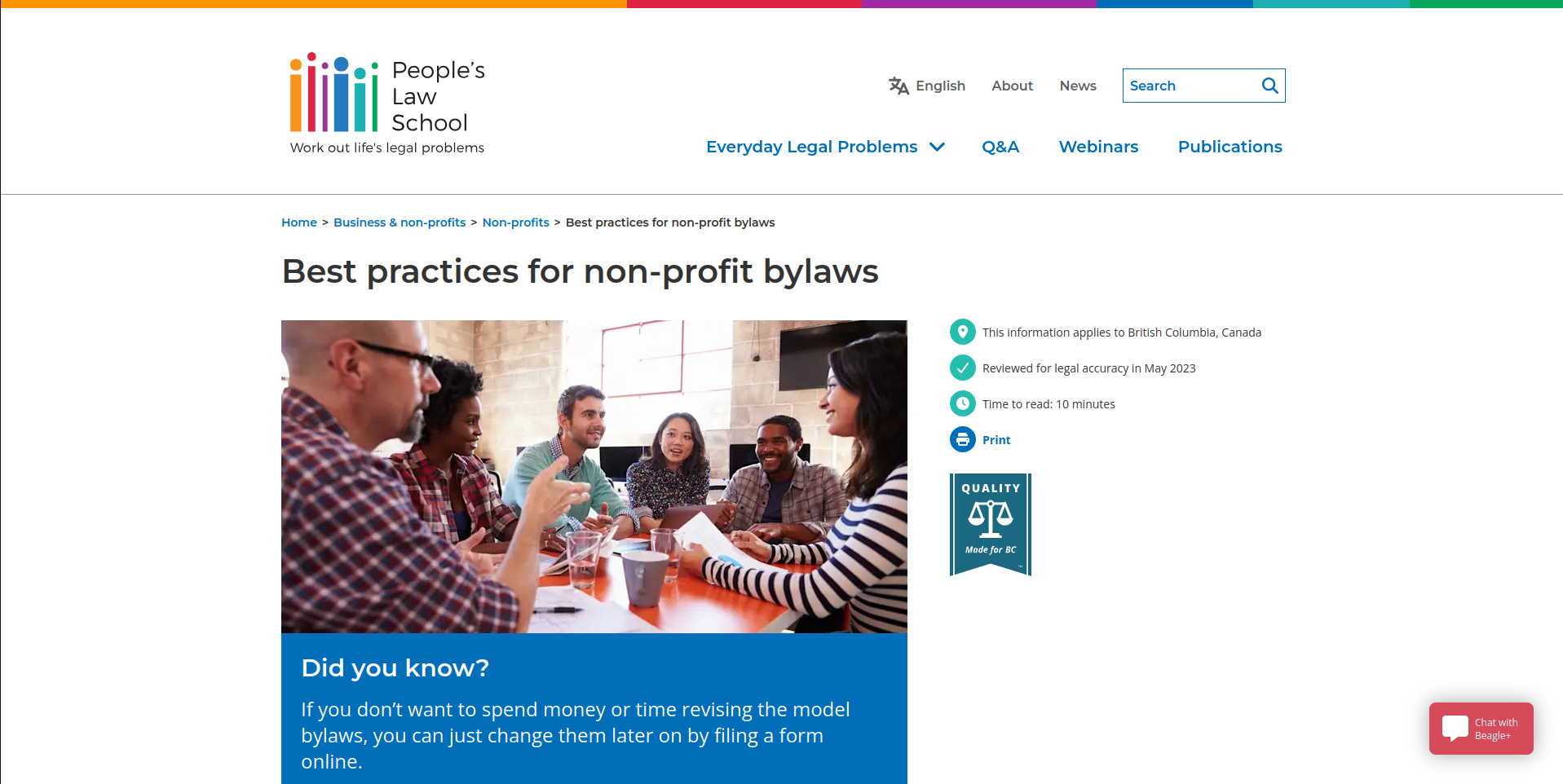
      Immediately after incorporation, usually during the first Board of Director's meeting, by-laws will be written and registered with the government. These are the rules that determine how the board itself carries out its business. Most provinces, as well as the federal government, offer simple bylaw templates you can use as-is, or modify according to your needs. You can also draft your own from scratch. The People's Law School recommends this latter approach, because it allows you to tailor your bylaws to your organizations particular present - and future - needs.

    • Best practices for non-profit bylaws

      People's Law School

      An accessible guide to drafting your own bylaws.  The focus is British Columbia, but most of the advice applies to any jurisdiction. This page features a large table of clauses you might want to include in your bylaws, and an explanation of each.

    • The purpose of by-laws is to avoid disputes among members by laying out clear rules of procedure. To do this, you must anticipate any possible cause of dispute. These can include:

        • The number and qualifications of directors
        • How directors are selected, how they can be removed and the time limits to their appointment 
        • Offices and committees
        • Procedures for handling conflict of interest
        • How meetings are called, who can call them and where they can be held
        • Meeting quorum
        • How the performance of a board is evaluated
        • Who can vote and how voting is conducted
        • When the AGM is held
        • Definition of the financial year
        • The process for opening a bank account
    • Review the by-laws of CHMA in Sackville New Brunswick (incorporated as Attic Broadcasting), which are typical of a community radio station constitution.

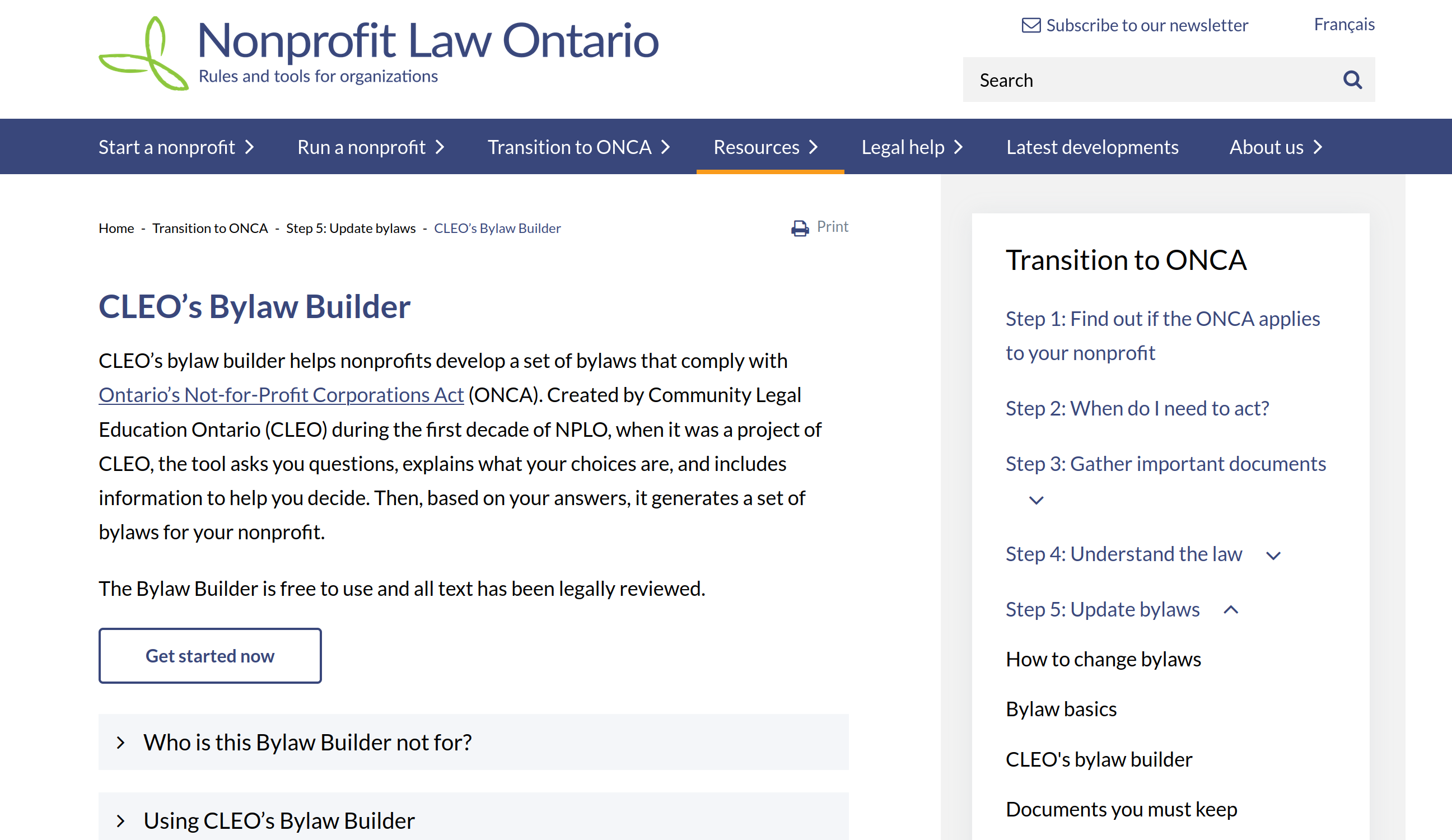
    • If you are creating by-laws from scratch you can start with an online by-law builder, such as the one provided by the Community Legal Education Ontario (CLEO) for Ontario-registered organizations. 

    • Ontario non-profit by-law builder 

      Community Legal Education Ontario (CLEO) 

      A fill-in-the-blank template for creating basic bylaws. These are for an Ontario registered non-profit. Check your provinces regulations for any differences.

    • Once by-laws have been created, they can only be changed through a vote of the organization's membership. In this way, by-laws bind future directors to the original vision of the organization's founders. This maintains stability within the organization. Occasionally, however, they may need to be rewritten, as Joe Delaronde of K1037 explains.

    • Rewriting the constitution

      Joe Delaronde


    • Mission, Vision, Values

      By-laws and purpose statements may be legally binding, they don't exactly roll off the tongue. This is where your mission, vision and values come in. These are short, well-crafted statements that serves as reminders to the public, staff and even yourself, what kind of organization you are running.

    • Vision

      Describes where an organization would like to be in the future; it is the organization's aspiration. 

      ...bring to Ottawa-Gatineau high-quality radio content produced locally and independently – meaningful, diverse, and inclusive – that supports and empowers the region’s interconnected communities to stay informed, engaged, entertained, and connected. CKCU Ottawa
    • Mission

      Outlines how it plans to get there, directing the efforts of people within an organization towards a common goal.

      ...to serve the evolution of culture, arts, and journalism in Northern BC by... searching for and championing local talent... connecting to our audiences... creating opportunities and educational experiences CFUR Prince George (excerpt)

    • Values 

      Sometimes called a code of ethics, values are the belief system that motivates the organization. The values explain why an organization acts the way it does, and delineates the behaviour it doesn't condone. 

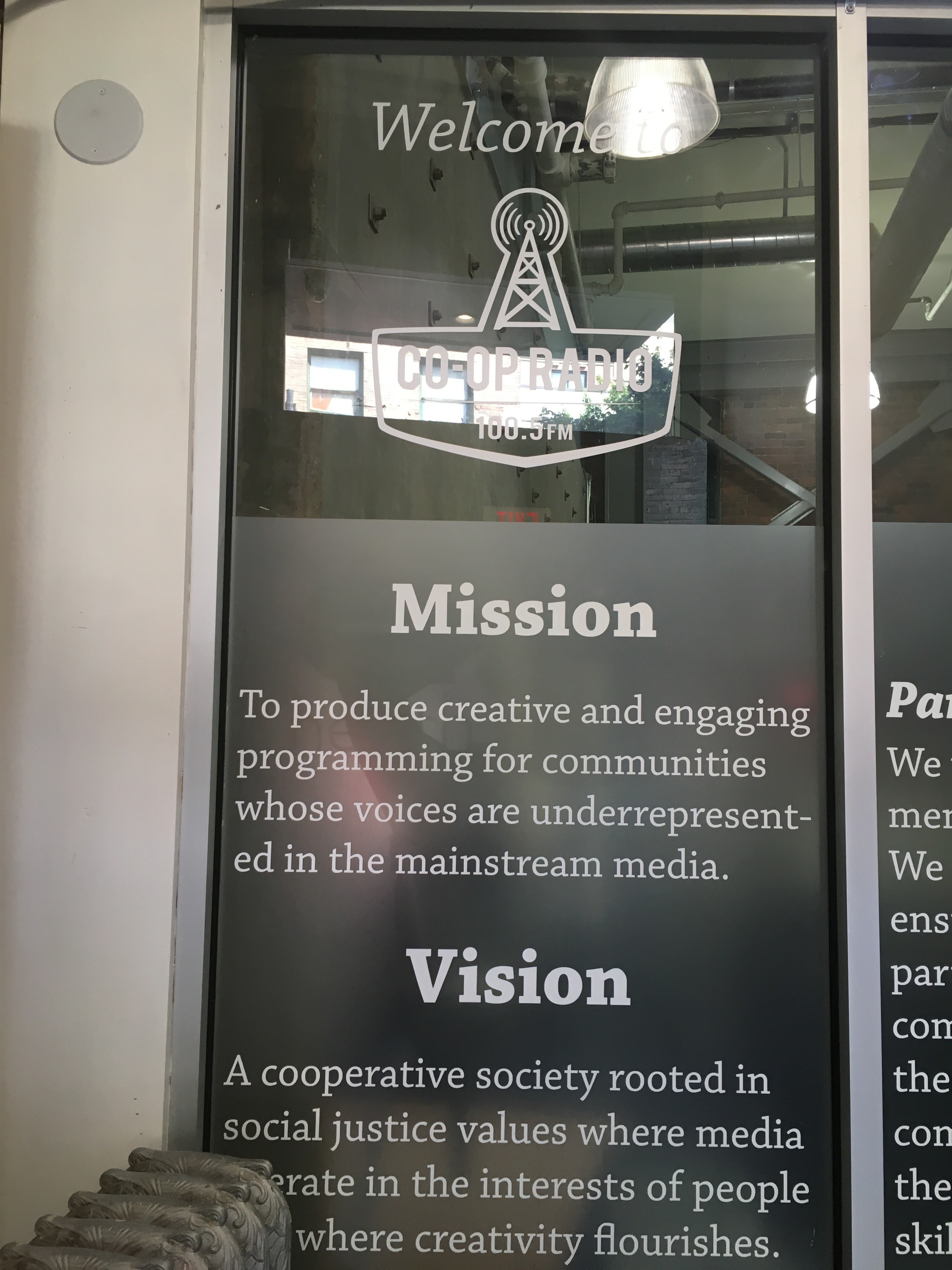
      We value and solicit the input of members and the community.  We work to reduce barriers to ensure accessibility and full participation of all the communities we serve. We value the knowledge and skills that community members bring to the station. We support skill-sharing through learning, sharing and teaching in order to encourage growth within the station and throughout the broader community. Vancouver Co-Op Radio (excerpt)

      To continue our chauffeur analogy: you need a vision (where you're going), a mission (how you will get there), and values (the rules of the road) to follow. Without all three, you can easily get lost.

    • Strategic Plan

      The strategic plan is where the rubber hits the road. A strategic plan is a document that outlines all the activities, programs and services an organization will carry out to achieve its mission. It specifies how success is to be measured, and a timeline for achieving it. Virtually every other decision of a board makes is judged against the strategic plan.

      In smaller organizations, the board itself creates the plan alone or alongside key staff. In larger organizations, the staff will create the plan and submit it to the board for approval. The board will also approve any budget needed to implement the plan.

      The strategic plan should be tightly linked to the mission and vision. Statements using the word "by" make the linkages clear. For example:

      We will increase listenership by running on campus marketing and outreach. 

      We will improve volunteering training by implementing on introductory online course.

      We will increase revenue by renting studio time to professional musicians.

      Find out more about strategic planning in 20 Questions Directors of Non-for-Profit Organizations Should Ask about Strategic Planning.

    • 20 Questions Directors of Not-For-Profit Organizations Should Ask about Strategy and Planning

      Hugh Lindsay

      An introduction to strategic planning for board: when to do it, and when to leave it to staff; how to match the plan with the budget; who are the stakeholders and how to get their input; how to evaluate the plan and those carrying it out. 

    • Once a strategic plan is in place, the organization can then assign specific tasks to individuals and committees, apply deadlines and apportion budget. Strategic plans should define activities for three to five years into the future, and be reviewed every year. The board should periodically ensure that the plan continues to be reasonable and aligns with the mission and vision of the organization. According to the Canadian Chartered Accountants Association, even the act of planning is valuable.

      Over time, the original passion and energy can get diluted by practicalities and problems, circumstances and needs may change and the organization risks losing its sense of purpose, relevance and commitment. Strategic planning is a way to invigorate and strengthen an organization by establishing longer range objectives and focusing on the important - not just the urgent. (Lindsay, 2008) 

       The best way to understand a strategic plan is to read one. Here's the strategic plan of CKCU radio.

    • CKCU in Ottawa recently (2025) drafted a new strategic plan that seeks to strengthen volunteer recruitment, diversify community connections and increase funding sources, among other actions.

    • Read your station's strategic plan. In what ways does it reinforce or further the station's mission, vision and values?