
Section outline

    • Board meetings are not always cosy fireside chats. There will be decisions and opinions you disagree with, sometimes strongly, topics that can only spoken of in secret, and times you may even be required to leave the room. Fortunately, there are well-established rules to handle these awkward moments.

    • Conflict of interest 

      The term sounds like something to avoid, almost shameful, but it's natural that board members are likely to face conflicts of interest in their course of duty. Given that most directors are chosen for their industry experience, most will have outside interests that could at some point compete or conflict with the interests of your radio station. Best practice, and the laws of most provincial regulators, define conflict of interest as:

      • A director, their business, or family and close friends, could benefit financially from a contract or other transaction with the station
      • A director sits on the board of another organization that may share interests with the station, or compete with it
      • A director uses their position to advance their own personal causes or policies unrelated to those of the station

      In a meeting, conflicts of interest will normally arise for agenda items that require a discussion and vote. If you find yourself in this situation, you must do the following:

      1. Note your conflict interest and the agenda item it conflicts with in the minutes
      2. Sit out the discussion and the vote

      Failure to take these steps could invalidate a decision of the board, including contracts signed with third parties, with directors personally liable.

    • Conflict of interest is not just about money. A romantic relationship between a board member and staff is also a conflict. If you're that board member,  make sure you declare your interest if the board discusses your partner's job performance.

    • Dissent

      If you don't agree with a decision made by the board, say so!

      Dissent and disagreement are sometimes seen as a failure of the board to achieve harmony. But experts say that isn't so. Here's Andrew and Nada Kakabase at boardagenda.com. 

      Contrary to popular belief, dissent doesn’t mean dysfunction. When directors challenge proposals, question strategies, or raise uncomfortable truths, they’re strengthening, not weakening, the board’s effectiveness.

      Constructive dissent pushes boards into testing assumptions, refining ideas, and reducing the risk of groupthink. It also enhances transparency and improves decision-making, especially in complex or high-risk scenarios.

      To express dissent, however, requires:

      1. A dissenter who is willing to speak against the majority and whose disagreement is with an issue, not a colleague
      2. A chair who maintains an atmosphere of balance and open-mindedness, in which dissenters feel able to speak up.

      Why dissent

      There may be many reasons to disagree with a decision:

      • You think the decision is against the interests of your station
      • You believe the decision is unethical or potentially illegal
      • You think the decision is based on information that is incorrect
      • You perceive a conflict of interest in members supporting the decision
      • You think the decision may break your station's by laws

      How to dissent

      You could just vote against a decision. However, you may want to go on record as having dissented. In which case, you should ask the secretary to note the way you voted and your reasons for dissenting in the minutes. This will protect you from personal liability if the decision goes horribly wrong. It also encourages debate amongst other members, and suggests transparency of the board as a whole, which in turns strengthens its credibility.

      You can also demand a roll call vote in which case every members position will be recorded. Remember, in most jurisdictions, if you don't record your dissent, you are legally considered to have voted in favour. And regardless of how you vote, once a decision has been made you are expected to abide by it as long as you are a board member.
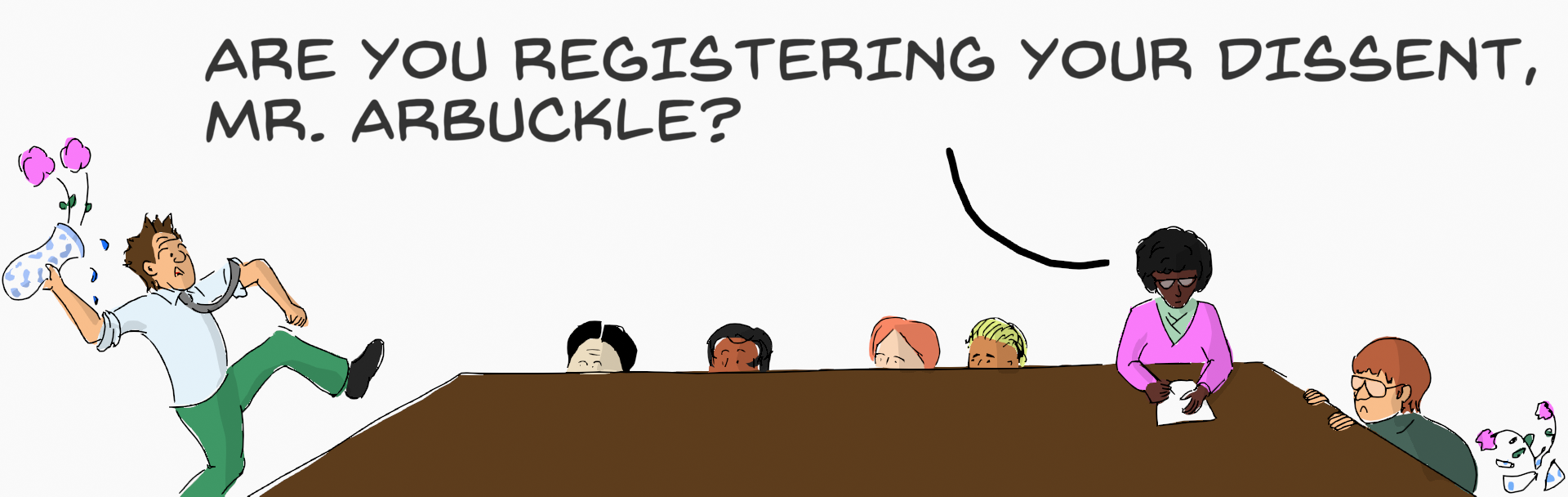
      A cartoon of a board room. Most members hide behind the table. One member is winding up to throw a vase against a wall. Unperturbed, the secretary askes "Are you registering your dissent, Mr. Arbuckle?"

    • In camera sessions

      There may be topics your board must discuss in secret, away from the ears of staff or other non-members who have been invited to the meeting. These secret sessions are called in camera (latin for "in a vault"). Examples of the topics you might what to discuss in camera are:

      • Positions to be taken during collective bargaining
      • Operational transitions (e.g. undertaking a strategic alliance)
      • Succession planning
      • Senior staff performance
      • Personnel items such as salaries
      • The evaluation of the Executive Director or Station Manager Compensation
      • Organizational failures (e.g. filing for bankruptcy)
      • The handling of conflict of interest situations
      • Discussions of a lawsuit currently aimed at the organization
      • Time-sensitive opportunities that can’t yet be made public

      In camera sessions are usually reserved towards the end of the agenda. Before the commence, anybody present in the meeting, including the station manager, is required to leave. It is not a legal requirement to take minutes of an in camera session, but it is recommended. These minutes can be kept separately from the open session minutes. Voting and all other procedures are the same. The result of a vote in camera may be recorded in the open minutes, but it is not required.