Section outline

    • A dozen people sit around a long board room table while one person stands and makes a presentation. Some people are listening, others are staring at their phones.

      In today's working world, dominated by shared calendars and Zoom calls, where endless "touching base" takes more time out the day than actual work, meetings have gotten a bad rap. But meetings are essential to the smooth functioning of any group activity. Meetings allow for discussion, for the sharing of ideas, view points and information. They allow a group to make decisions together, through the vote. And they keep the whole process visible and on the record, so nobody can come back later and say "I didn't know." 

      At least, they do if they are well run. This module is about running a meeting well.

    • An old-timey black and white photo of a bearded American Civil War-era military officer.

      Meetings need rules. 

      In 1863, US army officer Henry Martyn Robert was leading a meeting of church parishioners in San Francisco. The meeting quickly fell into disarray as everyone attempted to speak at once, the problem compounded, he recalled, by the diverse backgrounds and expectations of the members in this city of immigrants. To bring some order to his meetings, Robert compiled a set of rules, based loosely on parliamentary procedure of the US Congress. The book became known as Robert's Rules, and in North America, it remains the standard guide for anyone trying to run a meeting, from town councils to corporations to non-profits associations.

      Robert's key principles were:

      • Topics for discussion are agreed upon beforehand
      • Speakers may only discuss the topic at hand
      • Members may only speak in turn and when called upon 
      • Decisions are reached by vote, following discussion
    • Robert's Rules of Order

      RobertsRules.com

      The website of the descendants of Major Robert himself. At this site you can purchase canonical editions of the the original rules (there are various derivatives, copies and alternatives that do not have the family's blessing). It also has a very useful FAQ that dispels common myths about the rules.

    • Robert's Rules in action

      You can watch Robert's Rules in action in during the 2014 meeting of the Community Television of Santa Cruz County Board of Directors Meeting.

      Like most meetings, the subject is only of interest to it's members (and sometimes not even them) so you may find this video excrutiatingly boring. But if you've never been in a chaired meeting before, it is worth watching to appreciate the formality of the proceedings, and how scrupulously members stick to them.

    • Robert's Rules tutorial

      robertsrules.org

      This site (not to be confused with robertsrules.com, above) has tutorials and exercises to familiarize you with Robert's Rules.

    • Laws and bylaws

      Note that where an organization's bylaws set out rules of procedure, these take precedence over Robert's Rules. 

      The regulator where you registered your organization (normally the province) will also have laws concerning your meetings. These vary across jurisdictions. As an example, here is what the Ontario Not-for-Profit Corporations Act has to say:  

      • Whoever is calling the meeting (usually the chair) must give send out a written notice beforehand, with wording of resolutions
      • Financial statements to be presented must be sent to directors at least 5 business days before an annual meeting
      • Written notice of a meeting must be sent out 10 days in advance 
      • Quorum is 50% of members +1, unless stated otherwise in bylaws
      • Annual General Meetings's are to be held every 15 months and within 6 months of end of fiscal year
      • In person meetings must be held in Ontario
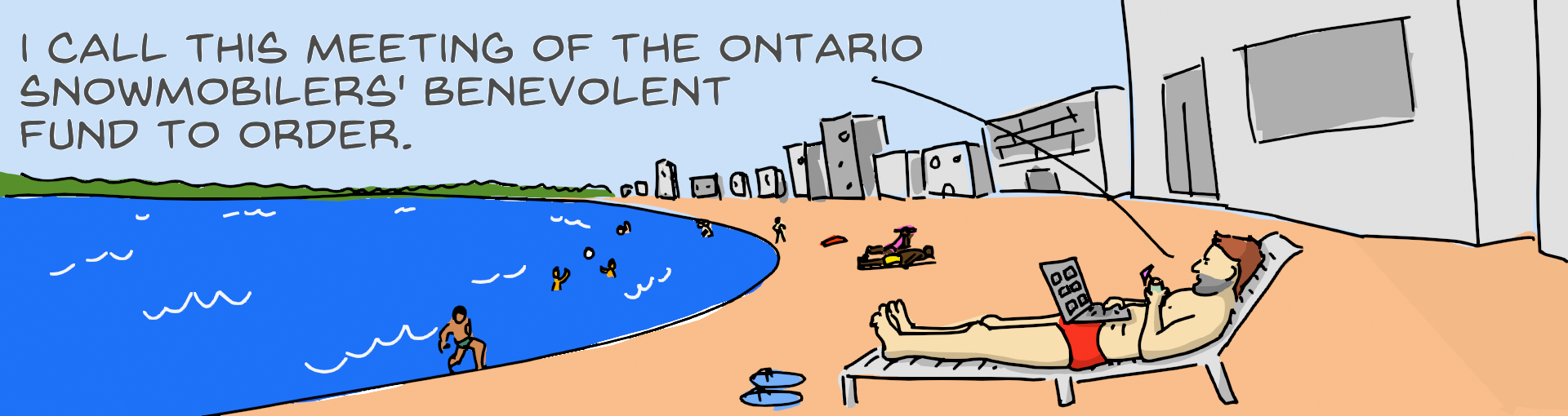
    • A cartoon of a man lying on a recliner at a beach resort. There is a laptop on his belly and he is holding a tropical drink. He says "I call this meeting of the Ontario Snowmobiler's Benevolent Fund to order."

    • The agenda

      Meetings run under Robert's Rules start with an agenda, an itemized list of activities to be discussed or otherwise carried out during the meeting. The agenda will usually drawn up by the organization's chairperson and secretary, with input from staff and other board members [IS THIS RIGHT? - CF]. It will include certain formalities and standard actions, such as roll call and voting on the agenda itself, as well as reports that must be made to the board by staff or committee members, topics that need to be discussed and actions to be taken. Each item will be allotted a fixed time for discussion so that - in theory - the meeting does not go on too long.

      A typical agenda follows this scheme:

      1. Call to order
      2. Roll call
      3. Adopting the agenda (members will vote on whether to follow the agenda as written or amend it.)
      4. Approving the minutes of the previous meeting
      5. Accepting staff and committee reports
      6. Old business (items carried over from the last meeting)
      7. New business (items being introduced at that meeting, including last-minute additions)
      8. Announcements
      9. Adjournment (formally close the meeting)

      The proposed agenda should be sent to members by the secretary at least four days before a meeting so they have time to prepare. If members wish to make amendments, they should file them with the secretary at least two days before the meeting. [I'VE SEEN THOSE TIMES CITED, BUT NOT SURE IF THEY ARE IN RR'S, WRITTEN INTO BYLAWS OR WHERE THEY COME FROM - CF]

    • An example agenda, for the NCRA's 2026 AGM.

    • A painting of members of the French National Assembly in uproar during the French Revolution.

      "The chair recognizes the French Revolution."

    • The chair

      The meeting chair leads the discussion, keeps order and ensures the rules are followed. In a board meeting, the chair will usually be the board or committee chairperson, or vice chair. It might also be someone outside the organization hired for the purpose. A chair is expected to lead the discussion with impartiality, and in larger meetings such as an AGM, will usually only vote in the case of a tie. 

      Here's a professional chair, Christopher Mines, explaining the basics of Robert's Rules at the opening of the 2026 Annual General Meeting of the NCRA (Item #5 in the example agenda, above) . As you listen, you can follow along with the description of motions, points and other actions below.

    • Robert's Rules

      Christopher Mines - NCRA AGM


    • The motion

      Every decision or action taken by a board meeting begins as a proposal, called a "motion." During a meeting, a proposal is moved, seconded, discussed and voted on.

    • Move the motion 

      Before an agenda item can be discussed, somebody must "move it", that is propose it.

      Second the motion

      Another person must second it for the motion to be discussed. If it receives no seconder, it "dies on the floor."

      Discuss the motion

      Put forward arguments for and against. Those wishing to speak can raise their hands, and the chair will call on them in order. You may express your opinion, or raise a procedural point (see below).

      Amend the motion

      At your turn, you may propose changes to the motion. All further discussion is about whether to accept the amendment until it is voted on. If an amendment passes, discussion is now on the amended motion. If it fails, discussion returns to the original motion.

      Withdraw a motion

      The original mover of the motion may withdraw the motion on their speaking turn, as long as there is no opposition.

      Vote on the motion

      At your turn you may also call to vote on the motion. If anyone opposes, there is now a vote on whether to vote. In this case, a two-thirds majority is required to go to a vote on the motion, otherwise a vote is called unopposed. If there are no more speakers, the motion automatically passes to a vote.  

    • Points and other actions

      Besides addressing a motion, speakers can take other actions. Points are not discussed or voted on, but are ruled on immediately by the chair. 

    • Point of order

      Raised when you believe a procedural rule has been broken, for example a ruling which conflicts with a bylaw or someone speaking out of turn.

      Point of information

      Raised to ask a clarifying question.

      Point of personal privilege

      Raised is your participation in the discussion is somehow impaired (you can't hear a speaker, for example).

      Table

      To postpone a motion until a specific time.

      Adjourn

      A motion to end the meeting. This goes straight to a vote, without the possibility of discussion, amendment, or reconsideration. A motion to adjourn cannot be made with someone else is speaking, a question has been asked or a vote is underway.

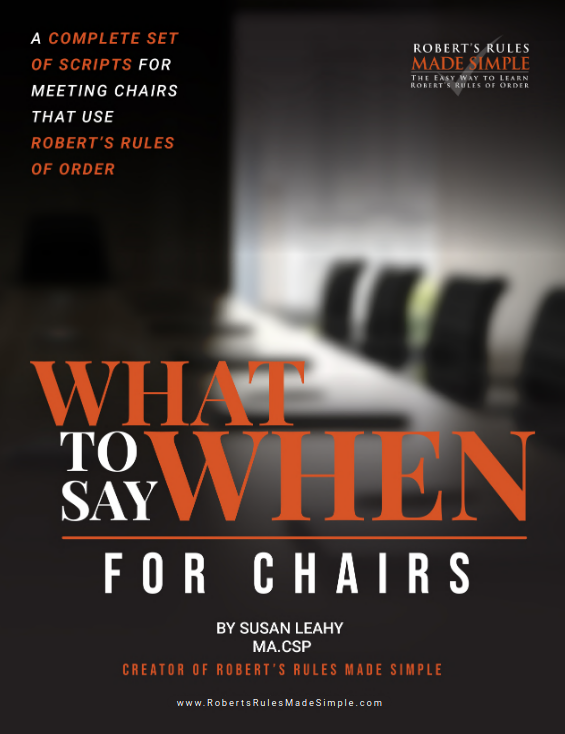
    • What to Say When for Chairs

      Susan Leahy

      An excellent collection of scripts of board meeting discussions, with commentary and advice. The scripts are intended to suggest language for Chairs to moderate discussions, but are equally useful for anyone who wants to know the proper language to raise a motion, move and amendment or challenge the chair. Recommended reading for anyone going cold into a board, committee or annual general meeting.

    • The vote

      ADD SOMETHING FROM HANDBOOK

      ROLL CALL VOTES 

    • Put the lines from this board meeting script into the correct order. Read What to Say When for Chairs (Leahy, n.d) for hints.

    • Stiff and formal?

      Meetings under Robert's Rules begin with a number of formal procedures that, while repetitive and mechanical, are important to get right. 

      Call to order

      "I call this meeting to order."

      This might sound like an archaic, high-faluting way to say "let's get started" but it is important to use this formal language to set the tone. It's an indication that the normal rules of conversation are at an end and Robert's Rules are now in effect.

      Roll call

      It's very important to make sure everyone present is correctly accounted for. On the other hand, going around the group and asking people to say "here" can be pretty tedious, not to mention error prone in a large group online. Listen to the efficient way roll call is performed during an online AGM at the NCRA, and note the correction that is requested at the end.

    • Roll call

      NCRA AGM 2026


    • Quorum

      Your meeting must always have a minimum number of attendees, called quorum. Unless your bylaws state differently, quorum is calculated as:

      Half the total number of board members + 1

      Your regulator may not recognize the meeting or the actions it takes if you do not have quorum. Make sure you have calculated the quorum before the meeting so you don' t have to do any math once the meeting has started! 

      A cartoon of a man and woman sitting alone at either end of a very, very long table. The man says "Do we have quorum?"

    • Setting the agenda

      An efficient meeting begins with the agenda. There are a number of ways you can set the agenda so that discussions remain focused and members engaged.

    • Question based agenda items 

      Broad open-ended topics can lead to broad open-ended discussion that goes nowhere as everyone takes the opportunity to speak their mind, however tangential to the point at hand. Try framing agenda items as a question with clear possible answers. Instead of "Buying a new mixing board", try "Should we buy a Solid State Logic for $84,000, a Behringer for $5000 or stick with what we have?" 

      Define objectives

      State the objectives of the meeting right at the beginning. For example, "at the end of this meeting we will have decided whether or not to purchase a new mixing board, and if so, which one; elected a new Secretary; and approved the yearly audit."

      Interesting presentations

      Much board time is taken up with reports from staff. These are necessary but can be a little dry. Mix things up with some presentations, testimonials or first-person accounts of the successes you've had or the impact you're organization has made since the last meeting. 

      Use your members to the full

      Select agenda items that call on members' particular skills or experience. They will feel valued and their committment will deepen, such that they are likely to increase their participation on other agenda items too.

      Action items

      Make a list of any undertakings that members make during a meeting. Assign a due date, and make sure you review the list during the next meeting, to ensure people stay on track

    • Paperwork

      Several days before a meeting, the board secretary, possibly with the help of staff or other board members, should distribute the following documents to all members where applicable:

      • The agenda
      • Draft of the minutes from the previous meeting (to be accepted or amended in this)
      • Any financial statements to be presented (balance sheet, income statement, a table comparing the budget to actual expenses)
      • The report from the executive director
      • Any committee reports to be presented

      Although the director, committee chairs, auditor and anyone else with a report to present may deliver an oral precis during the meeting, the bulk of the discussion will center on these written documents.

    • How long should a meeting be?

      To be able to answer that question you need to look at the purpose of your meeting. Talk to the people who are bringing business or items to the meeting, and find out, what is a reasonable amount of time which will be needed for each item, and do the math. Keep in mind that many peoples’ attention span seems to wane after a couple hours, so if you have a long meeting ahead consider adding in a break.

      Listen to NCRA board members debating whether to take a break. The discussion takes almost as long as the proposed break itself, but demonstrates an admirable committment to Robert's Rules. 

    • Taking a break

      NCRA AGM 2026


    • Outside the meeting

      Don't try and do too much in a single meeting. There are things you can do outside of the meeting to ease the burden on the agenda.

      • Try to hold an informal meeting outside of the board meeting to consult with interested stakeholders, address the largest concerns, and try to bring some recommendations to the meeting to help move the conversation forward
      • Delegate a subcommittee the tasks of doing research or making recommendations to the board.
      • Try splitting the meeting into more than one session.

    • What happens in a meeting must be written down. Nobody can possibly remember everything that happened in a single meeting, let alone many over the course of a board tenure. And even if they could, when a board member leaves they'll take those memories with them. Finally, if something goes wrong - a legal dispute, an audit or other scrutiny from regulators, accounting errors and other mistakes - you'll need a way to prove who said what and what decisions were taken.

      Those written records are called the minutes. They are usually taken by the secretary as the meeting is in progress, then distributed to board members for approval in the following meeting.  They are held in a safe place - either digitally or in print - and become your organization's institutional memory.

    • What should be recorded?

      According to the Canadian business law firm Miller Thomson, what you decide to record in the minutes of a board meeting is largely up to your organization. There are some minimum requirements by law, and guidelines of best practices.

      The law

      Provincial laws vary but most stipulate the following:

      • The name of the organization
      • The date and place where the meeting takes place. The exact time is not required, but you should specify whether morning, afternoon or evening.
      • The names of those present, their roles or offices, whether non-member guests, and whether they are present in person or online.
      • The text of any motions that have policy or financial implications
      • In votes requiring more than a majority, or votes requiring a ballot, the number of votes for and against and spoiled
      • Names of anybody declaring a conflict of interest, the nature of the interest, and the agenda item it conflicts with
      • The name and vote of any director who wishes their vote to be recorded (whether required or not) and their objections, where applicable.
      • The signatures of the chair and secretary

      Legally are you not required to record:

      • The mover and seconder of motions, nor the arguments for and against a motion
      • Defeated or withdrawn motions
      • Agenda items (such as background information or presentations) that require no discussion or vote

      Best practice 

      Nevertheless, minutes are the official record of your organization's decisions. They may be required to help make decisions in the future and may even be called on as evidence in court. We recommend you record:

      • All motions regardless of implications
      • Movers and seconders
      • A summary of arguments and discussion sufficient to explain the justification for a decision
      • Defeated motions
      • Any amendments to motions should be recorded.
      • Action Items (see above)
      • Confirmation of quorum

      Minutes can get unwieldy if you are try to record every last statement and nuance. Do not produce a transcript of the proceedings, almost the most important information. You can leave out:

      • Every comment, aside or statement. You're concerned with the decisions that are taken and the reason for taking them, not a blow-by-blow of the discussion that leads up to it.
      • The vote of each member, unless directors ask for a roll call vote (see above)
      • a motion that is withdrawn, although you may wish to include the gist of the discussion that took place
      • Too much detail that could create a liability in court. The board should not be held liable for off-the-cuff, exploratory or confidential statements in a discussion
      • Uneven detail. If some parts are highly detailed and others sparse, this may raise suspicions in court of deliberate omission
    • How do you do it?

      If you're the secretary, it may seem like a daunting task to keep up with the meeting without missing important details. Here are some tips for efficient minute-taking:

      • Stick to only the most important things, as noted above
      • Use bullet points, and abbrevs. These are still draft minutes that will be later tidied up and presented to the board for approval 
      • there is no requirement for the format. You can write by hand, on a computer, into the agenda itself or using a web service.
      • Don't write descriptive language, just stick to the basic facts (and definitely don't throw in your own opinion).

      A cartoon of a board meeting. Two members sleep, one stares at their phone, another looks at their watch, while one is standing, looking meek and unimpressive. In the foreground a hand writes a note: "The chair rose imperiously to his feet and to thunderous acclaim declared the motion carried."

    • These are the minutes from the NCRA's 2026 AGM. The minutes (in red) have been inserted directly into the agenda.

    • Are minutes a legal requirement?

      Yes. Regulators always require some form of record-keeping in meetings. The Ontario Corporations Act, for example, states: 

      A corporation shall cause minutes of all proceedings at meetings of the shareholders or members and of the directors and of any executive committee to be entered in books kept for that purpose.

      Any such minutes, if purporting to be signed by the chair of the meeting at which the proceedings were had... are admissible in evidence as proof, in the absence of evidence to the contrary, of the proceedings.

      In other words, from the point of view of a regulator

      take minutes or the meeting didn't happen!

      And even if minutes weren't a legal requirement, it is a foolhardy organization indeed that decides to operate without them. An absence of minutes is a big red flag for regulators such as the CRA!

    • Who has a right to see minutes?

      Board members and directors have a right to see them at any time, as well as auditors and in the case of legal or financial disputes, a court appointed investigator. The public does not have a right to see them. However, in the interests of transparency, some organizations decide to publish them anyway.

      Here are the minutes of Ottawa campus station CKCU.

    • Board meetings are not always cosy fireside chats. There will be decisions and opinions you disagree with, sometimes strongly, topics that can only spoken of in secret, and times you may even be required to leave the room. Fortunately, there are well-established rules to handle these awkward moments.

    • Conflict of interest 

      The term sounds like something to avoid, almost shameful, but it's natural that board members are likely to face conflicts of interest in their course of duty. Given that most directors are chosen for their industry experience, most will have outside interests that could at some point compete or conflict with the interests of your radio station. Best practice, and the laws of most provincial regulators, define conflict of interest as:

      • A director, their business, or family and close friends, could benefit financially from a contract or other transaction with the station
      • A director sits on the board of another organization that may share interests with the station, or compete with it
      • A director uses their position to advance their own personal causes or policies unrelated to those of the station

      In a meeting, conflicts of interest will normally arise for agenda items that require a discussion and vote. If you find yourself in this situation, you must do the following:

      1. Note your conflict interest and the agenda item it conflicts with in the minutes
      2. Sit out the discussion and the vote

      Failure to take these steps could invalidate a decision of the board, including contracts signed with third parties, with directors personally liable.

    • Conflict of interest is not just about money. A romantic relationship between a board member and staff is also a conflict. If you're that board member,  make sure you declare your interest if the board discusses your partner's job performance.

    • Dissent

      If you don't agree with a decision made by the board, say so!

      Dissent and disagreement are sometimes seen as a failure of the board to achieve harmony. But experts say that isn't so. Here's Andrew and Nada Kakabase at boardagenda.com. 

      Contrary to popular belief, dissent doesn’t mean dysfunction. When directors challenge proposals, question strategies, or raise uncomfortable truths, they’re strengthening, not weakening, the board’s effectiveness.

      Constructive dissent pushes boards into testing assumptions, refining ideas, and reducing the risk of groupthink. It also enhances transparency and improves decision-making, especially in complex or high-risk scenarios.

      To express dissent, however, requires:

      1. A dissenter who is willing to speak against the majority and whose disagreement is with an issue, not a colleague
      2. A chair who maintains an atmosphere of balance and open-mindedness, in which dissenters feel able to speak up.

      Why dissent

      There may be many reasons to disagree with a decision:

      • You think the decision is against the interests of your station
      • You believe the decision is unethical or potentially illegal
      • You think the decision is based on information that is incorrect
      • You perceive a conflict of interest in members supporting the decision
      • You think the decision may break your station's by laws

      How to dissent

      You could just vote against a decision. However, you may want to go on record as having dissented. In which case, you should ask the secretary to note the way you voted and your reasons for dissenting in the minutes. This will protect you from personal liability if the decision goes horribly wrong. It also encourages debate amongst other members, and suggests transparency of the board as a whole, which in turns strengthens its credibility.

      You can also demand a roll call vote in which case every members position will be recorded. Remember, in most jurisdictions, if you don't record your dissent, you are legally considered to have voted in favour. And regardless of how you vote, once a decision has been made you are expected to abide by it as long as you are a board member.
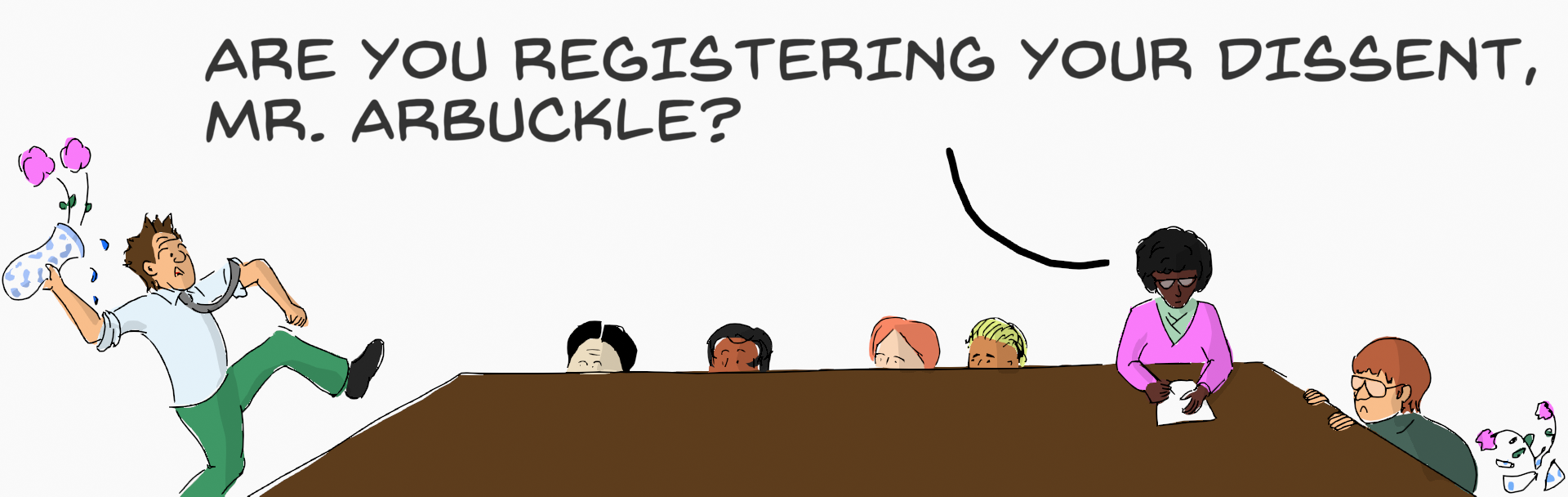
      A cartoon of a board room. Most members hide behind the table. One member is winding up to throw a vase against a wall. Unperturbed, the secretary askes "Are you registering your dissent, Mr. Arbuckle?"

    • In camera sessions

      There may be topics your board must discuss in secret, away from the ears of staff or other non-members who have been invited to the meeting. These secret sessions are called in camera (latin for "in a vault"). Examples of the topics you might what to discuss in camera are:

      • Positions to be taken during collective bargaining
      • Operational transitions (e.g. undertaking a strategic alliance)
      • Succession planning
      • Senior staff performance
      • Personnel items such as salaries
      • The evaluation of the Executive Director or Station Manager Compensation
      • Organizational failures (e.g. filing for bankruptcy)
      • The handling of conflict of interest situations
      • Discussions of a lawsuit currently aimed at the organization
      • Time-sensitive opportunities that can’t yet be made public

      In camera sessions are usually reserved towards the end of the agenda. Before the commence, anybody present in the meeting, including the station manager, is required to leave. It is not a legal requirement to take minutes of an in camera session, but it is recommended. These minutes can be kept separately from the open session minutes. Voting and all other procedures are the same. The result of a vote in camera may be recorded in the open minutes, but it is not required.

    • (NOTE: To move to minutes section: opencouncil.ca)

      Intro

      • What is an AGM
      • How does it differ from a regular board meeting?
      • Is it a legal requirement?

      NCRA OFFERS

      • 3rd party chair 

      RESOURCE

      • At least every 18 months (WHERE IS THIS DEFINED?
      • Financial year ends August 31 because that aligns with the broadcast year. Usually held in November to give auditor time to go through finances.
      • Open to public
      • Bylaws should specifiy
        • who can participate
        • when the fiscal year ends
        • how to elect board members and roles
        • how to change the bylaws (typically done at an AGM)
        • timing for notice around an AGM
        • if a proxy (DEFINE PROXY) is able to be used
        • number of members necessary for quorum

      Obligatory agenda items (EACH OF THESE ITEMS SHOULD BE EXPLAINED. IS THERE ANY DIFFERENCE BETWEEN THIS AGENDA AND THE REGULAR BOARD MEETING AGENDA?)

      • Call to Order 
        • WHAT DOES THIS MEAN?
      • Roll Call
        • WHAT DOES THIS MEAN?
      • Intro and approval of the Chair
        • ETC.
      • Approval of the Agenda
      • Intro of the Board & Staff
      • Approval of the previous years AGM Minutes
      • Board Report Overview
      • Staff Report Overview
      • Presentation of Auditor’s Report & Financial Statements
      • Appointment of Auditor (Chair)
      • Appointment of Elections Officers
      • Presentations from Nominees
      • Voting
      • Other Business
      • Announcements and Courtesy Motion (WHAT'S THAT?) (Optional)
      • Adjournment

      Optional agenda items (WHY ARE SOME DEPENDING ON BYLAW AND OTHERS NOT?)

      • Anti­-Oppression Check-­in (Optional)
        • WHAT THE BEJESUS IS THIS?
      • Presentation of Budget (Optional, depending on bylaws)
      • Motion to Extend Speaking Rights to Staff (Optional)
      • Candidate Question Period (Optional)
      • Election of President (Optional, depending on bylaws)
      • land acknowledgment when opening your presentation. Learn more here.

      TIPS

      • Time limits. AGM should last an hour or two. Reduce the amount of time for comments and debate.
      • Have a reception or entertainment before or after to draw more people. Think about catering/food options.

      NCRA OFFERS: AGM’s are a space for the business of the board of directors, not necessarily space for grievances to be aired (though this happens all the time).  The NCRA/ANREC runs what is called “Open Space”, a workshop that allows members to provide input and feedback based on their wants, without putting issues upfront which may or may not be appropriate or impact those in the room. Another space for operational or structural issues and discussions can be arranged. 
       

      VIDEO

      • Recorded AGM Meeting