Section outline

    • An old-timey black and white photo of a bearded American Civil War-era military officer.

      Meetings need rules. 

      In 1863, US army officer Henry Martyn Robert was leading a meeting of church parishioners in San Francisco. The meeting quickly fell into disarray as everyone attempted to speak at once, the problem compounded, he recalled, by the diverse backgrounds and expectations of the members in this city of immigrants. To bring some order to his meetings, Robert compiled a set of rules, based loosely on parliamentary procedure of the US Congress. The book became known as Robert's Rules, and in North America, it remains the standard guide for anyone trying to run a meeting, from town councils to corporations to non-profits associations.

      Robert's key principles were:

      • Topics for discussion are agreed upon beforehand
      • Speakers may only discuss the topic at hand
      • Members may only speak in turn and when called upon 
      • Decisions are reached by vote, following discussion
    • Robert's Rules of Order

      RobertsRules.com

      The website of the descendants of Major Robert himself. At this site you can purchase canonical editions of the the original rules (there are various derivatives, copies and alternatives that do not have the family's blessing). It also has a very useful FAQ that dispels common myths about the rules.

    • Robert's Rules in action

      You can watch Robert's Rules in action in during the 2014 meeting of the Community Television of Santa Cruz County Board of Directors Meeting.

      Like most meetings, the subject is only of interest to it's members (and sometimes not even them) so you may find this video excrutiatingly boring. But if you've never been in a chaired meeting before, it is worth watching to appreciate the formality of the proceedings, and how scrupulously members stick to them.

    • Robert's Rules tutorial

      robertsrules.org

      This site (not to be confused with robertsrules.com, above) has tutorials and exercises to familiarize you with Robert's Rules.

    • Laws and bylaws

      Note that where an organization's bylaws set out rules of procedure, these take precedence over Robert's Rules. 

      The regulator where you registered your organization (normally the province) will also have laws concerning your meetings. These vary across jurisdictions. As an example, here is what the Ontario Not-for-Profit Corporations Act has to say:  

      • Whoever is calling the meeting (usually the chair) must give send out a written notice beforehand, with wording of resolutions
      • Financial statements to be presented must be sent to directors at least 5 business days before an annual meeting
      • Written notice of a meeting must be sent out 10 days in advance 
      • Quorum is 50% of members +1, unless stated otherwise in bylaws
      • Annual General Meetings's are to be held every 15 months and within 6 months of end of fiscal year
      • In person meetings must be held in Ontario
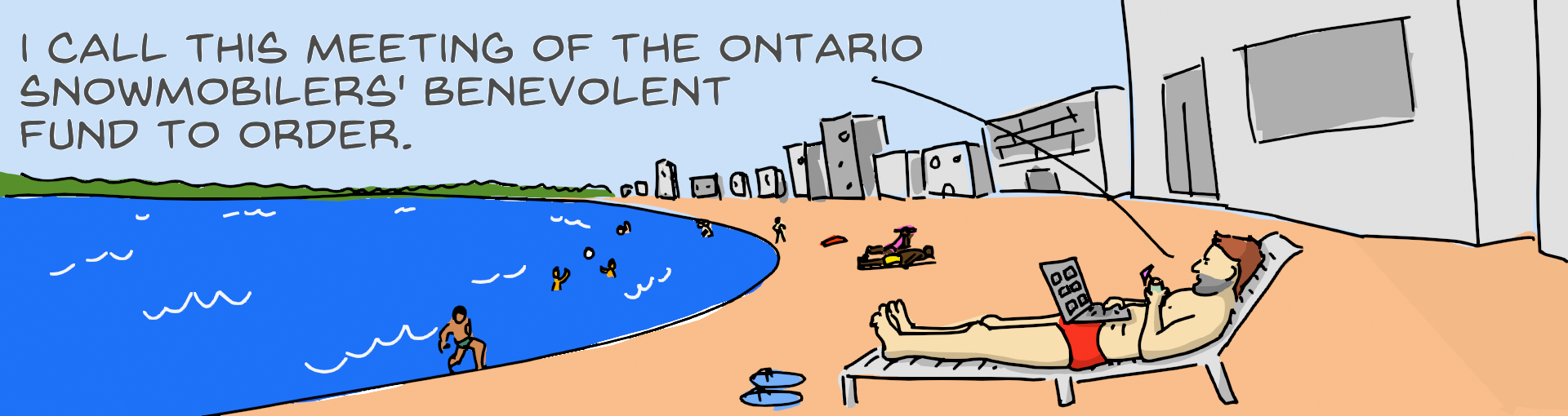
    • A cartoon of a man lying on a recliner at a beach resort. There is a laptop on his belly and he is holding a tropical drink. He says "I call this meeting of the Ontario Snowmobiler's Benevolent Fund to order."

    • The agenda

      Meetings run under Robert's Rules start with an agenda, an itemized list of activities to be discussed or otherwise carried out during the meeting. The agenda will usually drawn up by the organization's chairperson and secretary, with input from staff and other board members [IS THIS RIGHT? - CF]. It will include certain formalities and standard actions, such as roll call and voting on the agenda itself, as well as reports that must be made to the board by staff or committee members, topics that need to be discussed and actions to be taken. Each item will be allotted a fixed time for discussion so that - in theory - the meeting does not go on too long.

      A typical agenda follows this scheme:

      1. Call to order
      2. Roll call
      3. Adopting the agenda (members will vote on whether to follow the agenda as written or amend it.)
      4. Approving the minutes of the previous meeting
      5. Accepting staff and committee reports
      6. Old business (items carried over from the last meeting)
      7. New business (items being introduced at that meeting, including last-minute additions)
      8. Announcements
      9. Adjournment (formally close the meeting)

      The proposed agenda should be sent to members by the secretary at least four days before a meeting so they have time to prepare. If members wish to make amendments, they should file them with the secretary at least two days before the meeting. [I'VE SEEN THOSE TIMES CITED, BUT NOT SURE IF THEY ARE IN RR'S, WRITTEN INTO BYLAWS OR WHERE THEY COME FROM - CF]

    • An example agenda, for the NCRA's 2026 AGM.

    • A painting of members of the French National Assembly in uproar during the French Revolution.

      "The chair recognizes the French Revolution."

    • The chair

      The meeting chair leads the discussion, keeps order and ensures the rules are followed. In a board meeting, the chair will usually be the board or committee chairperson, or vice chair. It might also be someone outside the organization hired for the purpose. A chair is expected to lead the discussion with impartiality, and in larger meetings such as an AGM, will usually only vote in the case of a tie. 

      Here's a professional chair, Christopher Mines, explaining the basics of Robert's Rules at the opening of the 2026 Annual General Meeting of the NCRA (Item #5 in the example agenda, above) . As you listen, you can follow along with the description of motions, points and other actions below.

    • Robert's Rules

      Christopher Mines - NCRA AGM


    • The motion

      Every decision or action taken by a board meeting begins as a proposal, called a "motion." During a meeting, a proposal is moved, seconded, discussed and voted on.

    • Move the motion 

      Before an agenda item can be discussed, somebody must "move it", that is propose it.

      Second the motion

      Another person must second it for the motion to be discussed. If it receives no seconder, it "dies on the floor."

      Discuss the motion

      Put forward arguments for and against. Those wishing to speak can raise their hands, and the chair will call on them in order. You may express your opinion, or raise a procedural point (see below).

      Amend the motion

      At your turn, you may propose changes to the motion. All further discussion is about whether to accept the amendment until it is voted on. If an amendment passes, discussion is now on the amended motion. If it fails, discussion returns to the original motion.

      Withdraw a motion

      The original mover of the motion may withdraw the motion on their speaking turn, as long as there is no opposition.

      Vote on the motion

      At your turn you may also call to vote on the motion. If anyone opposes, there is now a vote on whether to vote. In this case, a two-thirds majority is required to go to a vote on the motion, otherwise a vote is called unopposed. If there are no more speakers, the motion automatically passes to a vote.  

    • Points and other actions

      Besides addressing a motion, speakers can take other actions. Points are not discussed or voted on, but are ruled on immediately by the chair. 

    • Point of order

      Raised when you believe a procedural rule has been broken, for example a ruling which conflicts with a bylaw or someone speaking out of turn.

      Point of information

      Raised to ask a clarifying question.

      Point of personal privilege

      Raised is your participation in the discussion is somehow impaired (you can't hear a speaker, for example).

      Table

      To postpone a motion until a specific time.

      Adjourn

      A motion to end the meeting. This goes straight to a vote, without the possibility of discussion, amendment, or reconsideration. A motion to adjourn cannot be made with someone else is speaking, a question has been asked or a vote is underway.

    • What to Say When for Chairs

      Susan Leahy

      An excellent collection of scripts of board meeting discussions, with commentary and advice. The scripts are intended to suggest language for Chairs to moderate discussions, but are equally useful for anyone who wants to know the proper language to raise a motion, move and amendment or challenge the chair. Recommended reading for anyone going cold into a board, committee or annual general meeting.

    • The vote

      ADD SOMETHING FROM HANDBOOK

      ROLL CALL VOTES 

    • Put the lines from this board meeting script into the correct order. Read What to Say When for Chairs (Leahy, n.d) for hints.